 Loading... Please wait...
- Home
- HOW TO BUY A KNIFE
HOW TO BUY A KNIFE
4 Steps to Buying the Right Knife from Buck Knives
1. How will you use it?
- Everyday: Are you opening boxes or cutting twine?
- Outdoor (Backpacking/Climbing/Hiking/Camping): Does your activity involve using rope?
- Hunting/Fishing: Are you field dressing game or cleaning/filleting fish?
- Tactical/Survival: Do you need a heavy-duty knife that won't fail?
- Limited Edition/Custom: Are you a collector?
- Fixed-blade: Always ready for use and dependable.
- Folding knife: Compact, safer to carry; improved dependability with locking blade.
- One-handed opening: Has a thumb stud, blade hole or other feature to facilitate one-hand use. Some models are one-hand opening and one-hand closing as well.
- Gutting/skinning blade: For field dressing game.
- Thick Blade: For heavy-duty tasks.
- Light weight: Use of composite or other materials to minimize weight.
- Saw edge: For cutting wood or bone.
- Sharpness: Stays sharp and is easy to sharpen.
3. What is it made of and why?
Blade Materials
A good blade combines good edge retention, ease of re-sharpening and rust resistance.
- S30V is the best blade steel available. It is a high vanadium stainless steel with even higher edge retention.
- ATS-34 and BG-42 are two custom steels with much higher carbon content, giving them higher hardness ratings and dramatically higher edge retention.
- 420HC is a stainless steel that provides excellent rust resistance, is easy to re-sharpen and has good edge retention.
A good handle should feel solid and well constructed when you hold it. We suggest you consider a handle style and material that meets your needs and suits your preference.
- An ergonomic design provides comfort.
- A rubber or textured handle provides a sure grip in wet conditions.
- A wooden handle adds beauty to the knife.
- Plastic/composite handles are durable under extreme conditions.
You want a knife that is crafted from high quality materials and will deliver reliable performance. If it should ever fail you, be sure the maker stands behind it.
Types of Knives| FIXED-BLADE KNIVES | |
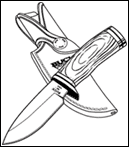 |
A fixed-blade knife will never surprise you in use because it is a solid piece of steel anchored to the handle. For those who want a blade they really trust for tough jobs, such as field dressing and tough camping tasks, a fixed blade is the answer. Fixed blades are durable and hold up to the elements well because of their straight, simple construction without folding mechanisms. In fixed blade knives, the blade is one piece of metal that runs the length of the knife. When the blade reaches the beginning of the handle, it can either taper into a rat-tail that is surrounded by the handle or not taper and continue as a tang that is covered on either side by handle "slabs." |
| FOLDING KNIVES | |
| Folding blade knives are generally not quite as durable as fixed blade knives, but provide safety and the carrying convenience of compact size. Folding blade knives come in a variety of configurations, some of which lock into place. Locking folders allow much of the same confidence of a fixed-blade while letting you close the blade into the handle for safety. | |
| Pocket Knife | |
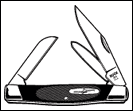 |
Good, old-fashioned pocket knives are still high on the list of favorites-great to carry in your pocket for all the times you might need a knife. Not all models lock open, but that's not critical for their utilitarian use. Some pocket knives offer multiple blades for different uses. |
| Lockback | |
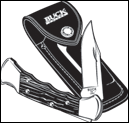 |
A "lockback" is a type of folding knife that locks open. Locking folders provide much of the confidence of a fixed-blade while open, yet enable you to fold the blade for safety and carrying convenience. A lockback gets its name from a rocking lock plate visible on the back of the handle. Opening the blade causes the "rocker" to lock against the blade so it locks open. Pushing down on the rocker at the back of the handle releases it and enables you to close the blade. Lockbacks require two-hand closing, though some are one-hand openers. |
| One-Hand Open/Close | |
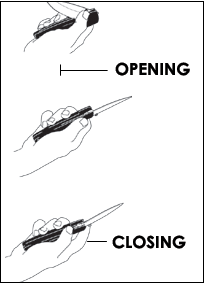
| Many knife users are looking for the convenience of a knife that opens and closes with one hand, and also provides lock-open safety. For climbing and activities where one hand is occupied, a one-hander is essential. For other activities, a one-hander may be the personal preference. There are many types of one-handers, so choose one that fits your activities. |
 |
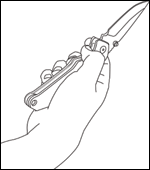 |
Liner Lock |
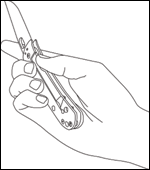 |
Frame Lock |
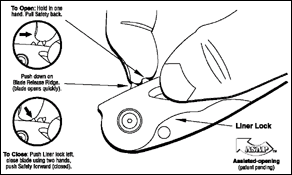 |
Assisted Opening |
End Use - How will the knife be used?
Buck Knives pioneered the concept of knife categories based on the end use of each knife. The materials and processes used to make each knife vary according to the end use. By providing knife categories, we feel it makes it easier for you to select a knife appropriate for your needs.
There are many options available, and this is not meant to cover every knife blade design configu-ration, but it will serve as a handy reference to some of the most common, with an indication of their intended purpose.
The three most commonly used blade shapes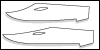 |
Clip - The length and angle of the concave curve on the non-cutting portion of the point determines whether a clip blade is just a "clip" (short, pronounced curve), a "California" clip (longer, gentler curve) or a so-called "Turkish" clip (very elongated). The sharp point is effective for detail work, but is not as strong as a thicker blade. |
 |
Modified Clip - A recent design development that has proved popular on high-tech, one-hand opener knives. Exact shapes vary. |
 |
Drop-Point - This blade has a gentle, sloping convex curve to the point without the concave curve of the clip blade. Its thicker point is stronger for heavier tasks. The thicker tip is a positive for abuse but a negative for easy penetration. |
 |
Sheepsfoot - Got its name from the shape of the point resembling the hoof of a sheep. With its distinctive flat, straight-line cutting edge and rounded point, it's well suited to giving you a clean cut, especially on a flat cutting surface. |
 |
Spey - As the name indicates, this blade was originally developed to neuter farm animals. Rather blunt point avoids poking through a surface by accident, and the overall blade configuration makes the spey function well suited for skinning and sweeping knife strokes. |
 |
Pen or Spear - This is a smaller version of the larger "spear point" blade. Spear points are more popular in Europe, while in America, the clip blade is the preferred option. Pen blades are usually on pocket knives as a handy, all purpose blade. It was originally developed to trim quill pens, and that name has stuck through the years. |
 |
Coping - A narrow blade with a sharp, angular point, almost like a miniature sheepsfoot blade, designed to be used for cutting in tight spots or curved patterns, much as you would with a coping saw, only without the teeth. |
 |
Tanto - The tanto is a traditional Japanese design dating back to feudal Japan. The angled grind from the edge to the tip is much heavier and stronger than other blade styles. It is used for piercing hard/tough materials and for prying or scraping. |
Blade Features
Blade Serrations (Serrated vs. Non-Serrated)On many blades, serrations have been added to give your Buck knife even greater cutting power.
 |
Serrated - Serrations, which might be considered a "semi-saw," provide a more aggressive cutting action, especially useful when cutting wet line, cord or cable. These blades have gained popularity, with the choice largely based on use of the knife. The serrations also retain their ability to cut longer than a standard edge. |
|
Non-serrated - These blades have a greater initial sharpness. For a clean, precision cut, a non-serrated blade is usually the first choice. |
 |
Partially serrated - Many blades are now offered partially serrated, providing the benefits of both cutting actions. |
 |
This is a special feature on the top of some of our Hunting knife blades (opposite the cutting edge on the bottom of the blade) for great performance with field dressing game. We have paid careful attention to the angles on the sharpened edge, shape and size of the entry opening, and location of the hook on the blade to make the Buck gut hook the best. |
Blade and Handle MaterialsA good knife begins with the finest quality materials for the blade, for the handle and for the other components that are essential to producing a dependable knife. Buck is always seeking ways to improve the quality, durability, look and performance of their knives. The information below reflects Buck's commitment to using the most appropriate combination of time-tested and innovative materials to make the highest quality knives.
Blade Materials
Since the blade is the heart of the knife, let's look at the metal as our starting point. Buck Knives uses steel for its knife blades. Steel is essentially a combination of iron and carbon. Steels used for knife blades are called alloy steels, which means they are enhanced by the addition of key elements, such as chromium, molybdenum, vanadium, manganese, zirconium, tungsten and more. The choice of steel is determined by the performance expectations of the blade. Different types of steel are produced by adjusting the chemical composition and the different finishing processes used; such as rolling, finishing and heat-treating. Stainless steels, the steels most commonly used for knife blades, are alloy steels with chemical additions that make them corrosion-resistant.
Types of blade steels
Different elements contribute different performance characteristics to the overall mix. No matter how good the steel, you are always faced with trade-offs: corrosion-resistance for edge-retention or edge-retention for sharpenability. To compare extremes, S30V steel provides the very best in edge retention and tensile strength, but is more difficult to re-sharpen and needs proper care. 17-7PH steel resists even salt water corrosion but cannot match the edge retention of harder steels. Buck has chosen the following steels:
 |
S30V - The absolute best blade steel available, and made in America. Contains carbon as well as high amounts of chromium, molybdenum and vanadium. Double-tempered, it can be hardened to a Rockwell hardness of Rc 59.5-61. |
 |
BG-42 Steel - An extremely high-performance, bearing grade, martensitic stainless steel with significantly increased amounts of carbon and molybdenum content plus vanadium for improved edge retention and strength. This steel can be hardened to Rockwell hardness of Rc 61-62. |
 |
ATS-34 Steel - A very high carbon, chromium martensitic stainless steel, with additional amounts of carbon and molybdenum that add significant edge-holding properties and corrosion resistance. This steel can be hardened to Rockwell hardness of Rc 60-61. |
 |
420HC Steel - This is a High Carbon (HC) version of standard 420 martensitic stainless steels. These steels are hardenable, straight-chromium steels. They combine the excellent wear resistance of high carbon alloys with the corrosion resistance of chromium stainless steels. That means 420HC, Buck's standard blade material, along with our exclusive heat-treat process, offers superior corrosion resistance and excellent tensile strength, hardness and wear resistance. It can be hardened to a Rockwell hardness of Rc 58. |
 |
17-7PH Steel - This alloy is used for high-strength applications that require high salt-water corrosion resistance and better edge retention than austenitic stainless steel. 17-7PH is defined as a chromium-nickel-aluminum precipitation hardening stainless steel, a process that develops hardness at relatively low temperatures, allowing hardening with very little distortion. This steel is excellent for water sports applications. It can be hardened to a Rockwell hardness of Rc 54-56. |
Handle Materials
Buck Knives selects from a wide variety of natural and man-made materials to provide the right handle for appearance and performance.
Wood - Beautifully grained natural woods and laminated dyed birch wood are chosen for more traditional knives (such as the 110 Folding Hunter). Some distinctive woods that Buck chooses are Cocobola, distinguished by its rich coloring, and Obechee with its unusually dark grained look. These woods are treated with an environmentally sound resin to protect their natural beauty.
Horn/Antler - Chosen for a distinctive, natural look, authentic horn and antler add extra distinction to any handle. They can be inlayed or hand-carved (Buck's black buffalo horn has been carved to replicate the natural grooves of Impala horn).
Phenolic - This hard, ebony-colored compound is almost impervious to heat, cold and shock, making it practically indestructible. This type of handle is best suited to a fixed blade knife that needs to withstand vigorous use.
Plastics - Buck uses various engineering-quality thermoplastics, including a molded plastic with a hard, textured surface and a rubber-like plastic with a textured finish. On some models, we use a two-shot molding method, combining a hard, glass-reinforced thermoplastic base with soft Dynaflex® to create a two-tone, sure-grip comfortable handle.
Aluminum - High-tech aircraft-grade aluminum 6061 T-6, machined from solid sheet stock can be used to create a lightweight and durable handle. The aluminum can be anodized in a solid color or with patterns and pictures. Buck Knives discovered a process that allows original artwork to be anodized on the handles.
Kraton® - Ideal for fish fillet knives, Kraton is a slightly pliant plastic, fully resilient when dry, for maximum comfort. Kraton becomes tacky when wet so you have a sure grip, even when hands get slippery.
G10 - An almost indestructible resin laminate that is resistant to heat, cold, chemicals, impact and other abuse. That's why Buck uses G10 for some of the handles on the super-tough Buck Strider tactical knives.
Titanium - An amazingly strong but surprisingly lightweight material; as close to corrosion free as you can get.
Quality and Craftsmanship
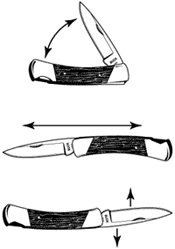
A knife is a tool-one that you should be able to count on. A well-made knife should provide you with many years of good service. At Buck Knives, a lot goes into the making of our knives. We feel it's the little things that make the difference. When purchasing a knife, here are some questions worth asking:
 |
|
Knife Sheaths
A good sheath is important
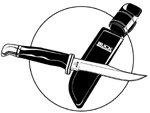 Fixed Blade Sheath 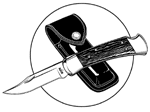 Folding Blade Sheath |
A good knife deserves a good sheath. A sheath should protect the knife (and its user), yet provide good access to it. Most have sheaths of high-quality leather or rugged nylon, depending on the style and use of the knife. All are designed for easy deployment of the knife. In many cases, they have either a vertical or horizontal configuration for convenient carrying. With fixed-blade knives, a sheath is crucial, since the blade does not fold away. With smaller knives, such as folders that easily fit in your pocket or feature an alternative carrying option, like a pocket clip or built-in carry clip, sheaths may not be offered. The sheath will usually wear out before the knife does. |
New Products
-
$145.00$75.00
-
$145.00$75.00
-
$190.00$90.00
-
$190.00$90.00
-
$260.00$135.00
